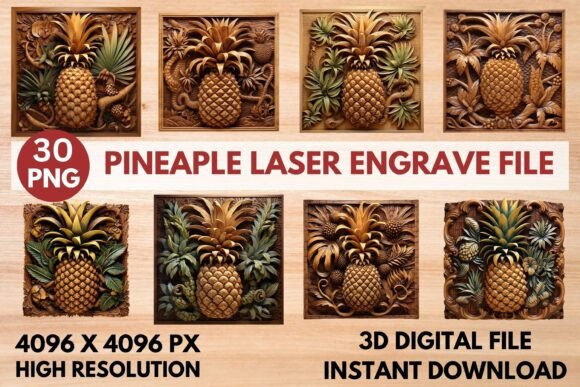
Pineaple Laser Engrave File: A Practical Evaluation for Digital Fabricators
In the realm of digital fabrication, the distinction between a vector cut file and a raster engraving file is fundamental. While SVG files dictate the path of a blade or laser beam to slice through material, PNG files—specifically high-resolution grayscale images—guide the laser’s intensity to create tonal depth, texture, and shading on a surface. For creators working with CO2 laser engravers, such as those using LightBurn, Glowforge, xTool, or Sculpfun machines, having access to precise, high-quality raster assets is critical for achieving professional-grade results. The Pineaple Laser Engrave File represents a specialized resource in this category, offering a premium set of designs intended to bridge the gap between simple line art and complex photographic realism.
This evaluation examines the technical specifications, practical applications, and workflow integration of the Pineaple Laser Engrave File and its companion asset, the Amazing 3D Laser Engrave PNG Ready-To-Print File. By analyzing these resources through the lens of usability and output quality, we can determine their value proposition for small business owners, hobbyists, and professional designers alike.
Understanding the Technical Foundation
The core utility of the Pineaple Laser Engrave File lies in its format. It is explicitly designed as a non-editable, high-resolution PNG set, which serves a specific purpose in the laser engraving pipeline. Unlike editable vector formats that require conversion or tracing software to interpret as dithered images, these files are ready-to-print raster graphics. This eliminates a common point of friction in the creative process: the time-consuming task of converting simple illustrations into effective grayscale maps for engraving.
The package includes two distinct sets of files:
- 15 Coloring PNGs (4096x4096 px): These files are likely optimized for techniques involving color layering or specific contrast adjustments, allowing users to manipulate brightness and saturation before sending the job to the machine.
- 15 Grayscale PNGs (4096x4096 px): These are the primary workhorses for standard grayscale engraving. The high resolution ensures that when scaled down for smaller products like coasters or tags, the pixel density remains sufficient to prevent jagged edges or loss of detail.
The transparent background feature is a significant advantage. In software environments like LightBurn, a transparent background allows the designer to place the pineapple design directly over a preview of the material or combine it with other elements without carrying over an unwanted white box. This flexibility supports more complex compositional workflows, enabling users to create layered effects or integrate the pineapple motif seamlessly into larger patterns for textiles or packaging.
Performance and Engraving Precision
The effectiveness of any raster engraving file is determined by how well it translates digital pixels into physical marks. The Pineaple Laser Engrave File is engineered for sharp detail and intricate results, which is particularly important for organic shapes like fruit textures. Pineapples possess a complex geometry of scales and leaves; a low-resolution or poorly dithered file would result in muddy, indistinct areas where the laser fails to differentiate between light and dark tones.
For users operating Glowforge machines, the recommended settings provided with the download offer a reliable starting point. The suggestion of Speed 1000 and Power 90 indicates that the file is tuned for deep, rich contrasts rather than shallow surface etching. However, the instruction to "Vary Power" and use a "Max Quality 5 LPI 270" setting suggests that the file benefits from dynamic power modulation. This means the laser will not fire at a constant intensity but will pulse based on the pixel values, creating smooth gradients. This is crucial for achieving the "Amazing 3D" effect mentioned in the companion product description, where shadows and highlights give the illusion of volume.
When used with LightBurn, the application of a Jarvis Dither filter is highly recommended. Dithering algorithms convert grayscale data into patterns of dots that the eye perceives as continuous tone. The inclusion of a grayscale PNG reduces the need for aggressive real-time dithering, which can sometimes introduce noise or artifacts. By providing a pre-processed image, the file ensures consistency across multiple production runs. Whether you are engraving ten signs or one thousand coasters, the output remains uniform because the source data is stable and high-fidelity.
Material Compatibility and Workflow Integration
One of the most critical factors in laser engraving is material selection. The documentation notes that lighter woods yield the best results for this specific file. This is a practical observation rooted in physics: darker woods absorb more laser energy, which can lead to burning rather than clean engraving, especially when using high-power settings. Lighter woods, such as basswood, maple, or birch, provide a neutral canvas that allows the full range of the grayscale palette to shine through without interference from the wood’s natural pigmentation.
The file’s versatility extends beyond wood. Because it is a PNG-based engraving file, it performs effectively on acrylics, leather, glass (with coating), and coated metals. For textile art, the fine detail of the pineapple design allows for intricate embroidery-like patterns when engraved onto fabric-backed materials. Similarly, for stationery and paper crafts, the high resolution prevents the "halo effect" often seen around engraved text or images on thin substrates.
It is imperative to note that this is not an SVG cut file. Users expecting to use this design for vinyl cutting or routing should be aware that the file contains tonal data, not vector paths. Attempting to send this PNG to a cutter will result in the machine attempting to trace the outer boundary of the entire image block, rather than cutting out the pineapple shape. This limitation defines the audience: this tool is strictly for engravers, etchers, and printers who utilize raster-based workflows.
Target Audience and Use Cases
The Pineaple Laser Engrave File caters to a broad spectrum of creators, each deriving different value from the asset:
- Small Business Owners: Entrepreneurs producing home décor items, wooden signs, or tableware can leverage this file to add premium, detailed branding or decorative elements. The ability to produce intricate designs quickly reduces the barrier to entry for high-end looking products.
- Fashion and Textile Designers: Those creating custom apparel or accessories can use the PNGs for laser cutting or engraving on leather patches, denim, or synthetic fabrics. The grayscale nature allows for subtle branding that doesn’t overpower the garment.
- Packaging Designers: For brands seeking eco-friendly or artisanal packaging, laser-engraved cardboard or wood boxes featuring this pineapple motif offer a tactile, luxurious unboxing experience.
- Hobbyists and Educators: Beginners in the laser community benefit from the "ready-to-print" nature of the file. It removes the technical hurdle of image processing, allowing them to focus on learning machine operation and material properties.
Furthermore, the companion "Amazing 3D Laser Engrave PNG" suggests that users interested in photorealistic effects will find this ecosystem valuable. By combining standard engraving with 3D relief techniques, creators can produce stunning visual depth that mimics carved stone or sculpted wood, elevating simple pineapple motifs into statement pieces.
Limitations and Considerations
No digital asset is without constraints. The primary limitation of the Pineaple Laser Engrave File is its static nature. Since the PNGs are non-editable, users cannot adjust the thickness of lines or modify internal details without external editing software. If a user requires a minimalist version with fewer details, they must perform that reduction themselves. Additionally, the reliance on specific software settings means that users with older or less capable laser drivers may struggle to replicate the exact "Max Quality" results shown in promotional materials. Calibration of the machine is essential; a poorly calibrated laser will distort the delicate gradients intended by the file’s design.
Another consideration is the file size. At 4096x4096 pixels, the files are substantial. While modern computers handle this easily, transferring large batches of jobs to networked lasers or managing storage for extensive libraries requires adequate digital infrastructure. However, for the vast majority of desktop users, this is a negligible inconvenience.
Final Assessment
The Pineaple Laser Engrave File stands out as a well-crafted resource for anyone serious about laser engraving. Its strength lies in its preparation: by providing high-resolution, transparent, grayscale-ready assets, it streamlines the workflow from concept to finished product. The inclusion of specific settings for popular platforms like Glowforge and LightBurn demonstrates an understanding of the user’s technical needs, reducing trial-and-error time.
While it does not replace the need for skill in material selection and machine calibration, it significantly lowers the barrier to achieving professional-looking engravings. For creators looking to expand their inventory with unique, detailed designs without investing hours in graphic design, this file offers tangible efficiency and aesthetic value. It is a practical tool that respects the technical realities of laser engraving while delivering on the promise of intricate, beautiful results.